Investment Newsletter Using Spinoffs & Other Strategies To Beat The Market For 9 Straight Years Investment Newsletter Using Spinoffs & Other Strategies To Beat The Market For 9 Straight Years Investment Newsletter Using Spinoffs & Other Strategies To Beat The Market For 9 Straight Years Investment Newsletter Using Spinoffs & Other Strategies To Beat The Market For 9 Straight Years  
Home        
Performance of Our Portfolios
Current Articles
Current Recommendations (Subscribers Only)
Spin-Off Calendar (List of Current & Pending Spin-Off Stocks)
How It Works
FAQs
Investing 101
Links to the web's best investment research sites
Financial Calculators
About us
Contact Us
Subscribe
 

Why Mutual Fund Expense Ratios Matter. How 0.5% In Higher Fees Can Cost You $25,000

12/23/03 Do you ever check your mutual fund’s expense ratios? Well, you should because one study shows that there’s an 89% chance that your funds will under-perform if their expense ratios are above average. We'll also show you that switching to a fund with an expense ratio that is 0.5% lower than your current fund can save you $25,000 or more over time.

Standard & Poor’s recently did a study that showed that "on average, funds with lower expense ratios have outperformed their more expensive peers in eight out of the nine domestic fund style categories over a one, three, five, and ten-year annualized basis." In other words, 89% of the time, funds with expense ratios lower than their peers outperform those with higher expense ratios. A lower expense ratio does not guarantee better performance, but the study shows that choosing funds with low expense ratios increases your odds of success. And isn't investing all about putting the odds in your favor?

But let’s just ignore the fact that funds with lower expense ratios tend to outperform those with high expense ratios. Let’s assume that we have two funds that perform the same before expenses, but one has an expense ratio of 1.5% and the other has an expense ratio of 1.0%. What kind of difference can a half of one percent make? Over time it can make a big difference.

As an example, let’s assume $50,000 is invested in the two mutual funds for ten years. The fund with the lower expense ratio would have earned over $5,000 more. After twenty years, the difference grows to nearly $25,000. An amount equal to almost one half of your initial investment would be saved with the mutual fund with the lower expense ratio. So who says a lousy half a percent doesn't amount to anything?
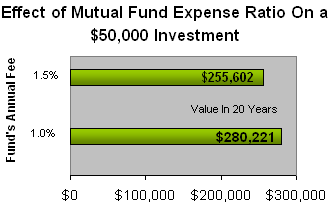
 

Expense Ratios Just 0.5% Lower Can Save You $25,000 Over Time


Don’t compare apples to oranges.

One thing to keep in mind is that you must compare mutual fund expense ratios with other mutual funds in the same category. This is because some types of mutual funds (such as international stock funds) will almost always have higher expense ratios than other types of funds (such as index funds). Just make sure to compare index funds versus other index funds and international funds versus other international funds.

So how do you find out if the mutual funds you are interested in have expense ratios lower than their peers? With the Internet, it's easy. You could go to Yahoo Finance’s mutual fund “Profile” pages or Morningstar.com ‘s “Fees & Expenses” section for the funds in question. Because web pages may change over time, just drop us a line if you have trouble locating this information. We'll quickly point you in the right direction because we are very familiar with this type of analysis. It’s just one of the many characteristics we look for when searching for the mutual funds to recommend to the subscribers of our investment newsletter.

-Rex M. Jacobsen
Sr. Editor

This article may be re-published as long as the following resource box is included at the end of the article and as long as you link to the URL mentioned in the resource box:

Article by Rex M. Jacobsen, Sr. Editor of the investment newsletter Beat The Stock Market.com. Since 1998, the company's model portfolio has achieved a return of 32.8% per year. The company's web site can be found at http://www.BeatTheStockMarket.com.


32.8% Average Annual Gain For Our Primary Stock Portfolio (Spin-off Stocks) Since 1998

(Log-In -- Log-Out)

News About Recommended Stocks, Mutual Funds, & Events on Wall St.
(Complete Article List)

06/27/2008

Buy/Sell Signals For Primary Stock Portfolio, International Stock Portfolio, & Speculative Spin-offs

More>>

06/15/2008

Seven Stocks Receive Rating Changes

More>>

05/31/2008

59% Gain In Two Months Leads To Rating Change

More>>

05/11/2008

Spin-off Stocks Again Leading Market On The Way Up -- Also, Four More Dividend Increases

More>>

04/15/2008

Dividend Boosted 16% This Quarter -- Firm Has Raised Dividend 60% In Three Years

More>>

03/31/2008

Several Buy & Sell Signals, Including Taking 181.9% Profit On Energy Investment, 170.8% Gain On Insurance Co. -- Average Gain Is 61.2% On All Eight Sell Signals

More>>

03/23/2008

Market Timing Usually Leads To Disaster

More>>

03/12/2008

Two More Dividend Increases -- 34 Consecutive Years of Dividend Increases

More>>

02/29/2008

Buy & Sell Signals: Time To Sell Bottling Co. For 53.6% Gain In Ten Months

More>>

02/27/2008

46th Consecutive Annual Dividend Increase -- Stock Up 18.3% Versus
-5.6% For S&P 500

More>>

02/17/2008

Rating Changes

More>>

02/15/2008

Warren Buffett Purchases Large Stake In Kraft

More>>

02/05/2008

The Last Time Insiders Were Buying At This Rate Signaled The End Of The Last Bear Market

More>>

01/22/2008

Today's Rate Cut: Stock Market Averages +17% Over Next Twelve Months After Fed Cuts Rates

More>>

01/16/2008

Two More Dividend Increases -- 10 Consecutive Quarters of Increased Distributions

More>>

01/15/2008

Insurance Unit Spin-off Announced Today

More>>

01/09/2008

Another Dividend Hike -- Update on 5-way Spin-off

More>>

01/04/2008

Cornerstone Growth Stockscreen Updated 1st Friday Of Each Month

More>>

12/31/2007

Selling Video Game Retailer For 500%+ Gain In 33 Months

More>>

12/26/2007

Year-end Dividend Increases and Distributions

More>>

12/19/2007

Buy Signal For Primary Stock Portfolio

More>>

12/16/2007

Stock Market Activity Creating An Abundance Of Bargains

More>>

12/11/2007

Our Leading Gainers Since
Date of Recommendation

More>>

12/11/2007

Dividend Increased By 11% -- Four Consecutive Years Of Double-Digit Dividend Boosts -- 32 Consecutive Years Of Dividend Increases

More>>

12/07/2007

Two Sell Signals For Primary Stock Portfolio

More>>

12/07/2007

Cornerstone Growth Stockscreen Updated 1st Friday Of Each Month

More>>

11/28/2007

Verigy's Stock Surges 28% Today After Quarterly Results Released

More>>

11/21/2007

Buy Signal For A Spin-off Founded In 1869

More>>

11/16/2007

LSI's Dividend Is Growing 29% Annually

More>>

11/14/2007

Biotech Spin-off

More>>

11/09/2007

Potential Luxury Auto Spin-off, Plus Two New Spin-off Companies

More>>

11/07/2007

Cure For a Choppy Market: Another Dividend Boost Means 27 Consecutive Years of Dividend Increases At A Compound Rate Of 21% Per Year

More>>

11/07/2007

Two New Spin-off Companies

More>>